
From the Payphone Era to Smart LED Lighting
Three decades of technological change, and how a Mumbai electronics company that once built payphones for India's PCO booths now focuses on LED and emergency lighting technology.
Think back to the yellow board that once stood on almost every street corner in India: STD · ISD · PCO. For a generation, that small booth was where families shared news, businesses closed deals and students called home. Today, the same need, to stay connected and to keep life running smoothly, is met by very different technology.
Lighting has gone through a similar change. The tube light and the bulb have given way to LEDs, and a power cut no longer has to mean darkness on a factory floor or a building staircase. This article traces that journey through MULTiSSCAN's own story, and explains what modern emergency lighting technology means for the spaces you manage today.
The Payphone Era: Where Our Journey Began
Before mobile phones reached every pocket, the PCO booth was India's communication lifeline. Long-distance calls were planned, timed and often made late at night when rates were lower. The booth owner, the call meter and the printed bill were all part of an everyday ritual.
- Waiting in a queue outside the booth for your turn to call?
- Watching the call meter count up while you spoke as fast as you could?
- Collecting a printed slip at the end of every STD call?
- Shutting the glass door so the street noise would not drown the conversation?
Trisha Electronics & Communications began its journey in the telecommunications industry in 1992. We launched the MULTiSSCAN brand in 1998 for products serving India's PCO market. Around 2000, we imported payphone housings from Star Electronics in Bangkok, Thailand, for about a year. Our range included wall-mounted PCO phones, coin-operated desktop payphones, STD PCO monitors and local call meters.
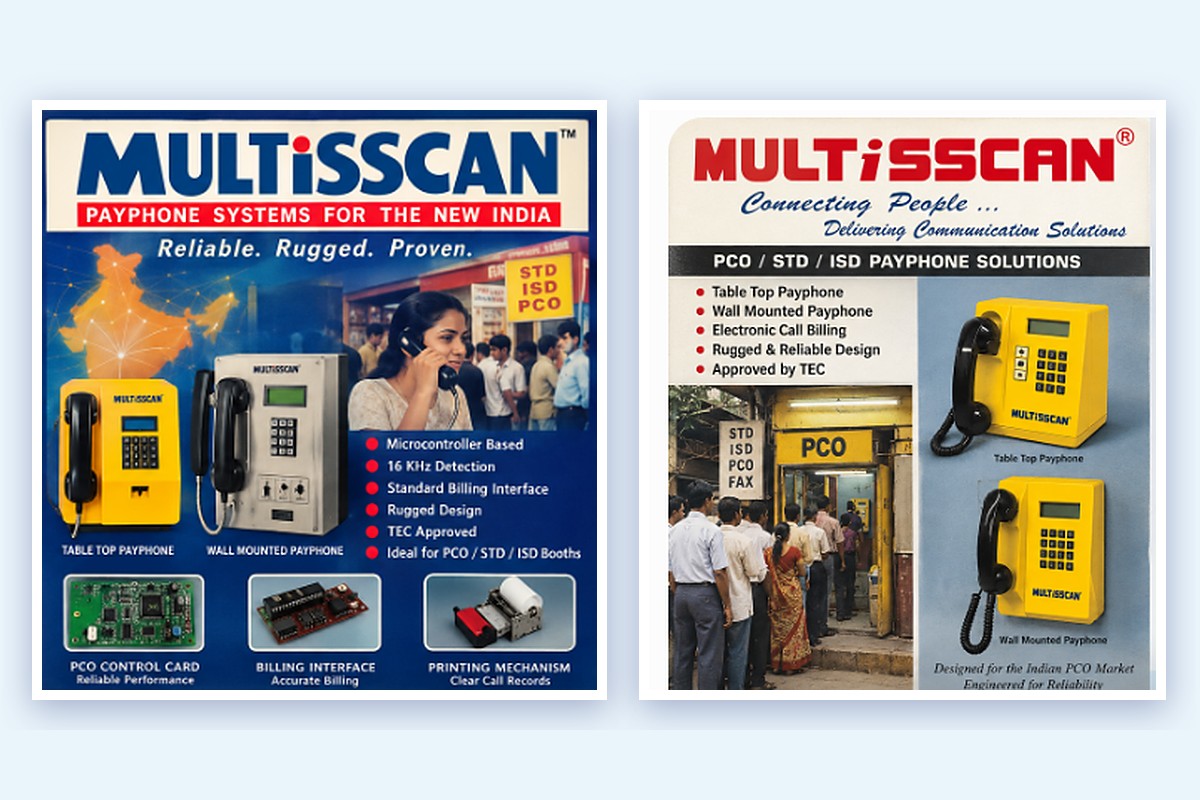
Then the mobile revolution arrived. As calls on mobile phones became affordable for almost everyone, the PCO booth's role declined quickly, and with it the market for payphone equipment. It was a clear lesson that technology never stands still. What stayed with us was something more valuable than any single product: years of hands-on experience in designing and building electronics meant for continuous, everyday use.
Journey begins in India's PCO and payphone industry
MULTiSSCAN brand launched for payphone products
Payphones decline as mobile calling spreads
LED, industrial and emergency lighting solutions
From Communication Technology to Lighting Technology
A payphone and an LED luminaire look nothing alike, but underneath they share a lot: power supplies, control circuits and electronics that must work reliably for long hours. That background in electronics and communications became the base for our move into LED lighting solutions.
The goal is the same as it was in the PCO days: solve an everyday problem dependably. Good lighting is not a luxury. It is part of how people work safely and efficiently. Consider where visibility matters most:
If you are planning lighting for any of these spaces, you can explore our lighting products to see the options available.
Emergency Lighting Technology: Light When It Matters Most
In Mumbai and across India, a power cut is a familiar experience, whether it comes with a monsoon storm or a fault in the local supply. At home it is an inconvenience. On a factory floor, in a warehouse aisle or on a staircase, sudden darkness can stop work and put people at risk.
Emergency lighting is designed for exactly that moment. During normal operation, the light works like any other fitting. When mains power fails, it switches automatically to its battery, so illumination continues without anyone having to find a torch or a switch. When power returns, the battery recharges and is ready for the next interruption.
Emergency LED high-bay lights
High-ceiling spaces such as warehouses and industrial sheds are among the hardest places to be caught in the dark. An emergency high-bay light with an integrated battery-backup system combines everyday overhead lighting with emergency operation in one fitting, helping maintain visibility and operational continuity during an outage.
Emergency LED luminaires for other spaces
The same idea applies to other emergency LED lighting, such as panels, tube lights and street lights with battery backup, for offices, corridors, stairways and outdoor areas.
The right solution depends on the space: ceiling height, the area to be covered, how long backup is needed and how the site is used. A product that suits a corridor may not suit a 10-metre-high warehouse, so it pays to discuss the application before choosing.
Explore MULTiSSCAN Lighting ProductsEmergency, industrial, indoor and outdoor LED lighting.
View ProductsSimple care keeps emergency lights ready
- Test periodically by simulating a mains failure, as recommended by the manufacturer and any applicable safety requirements.
- Keep fittings clean, especially in dusty industrial spaces, so light output is not reduced.
- Check battery health over time; rechargeable batteries age and eventually need replacement.
- Use a qualified electrician for installation and wiring.
Why LED Lighting Is Here to Stay
Just as mobile phones replaced the payphone, LEDs have steadily replaced older lighting technologies. The reasons are practical:
- Lower electricity use: energy-efficient LED lighting typically consumes less power than many traditional technologies for a comparable lighting requirement.
- Long service life when the product is well designed and operated within its intended conditions.
- Less maintenance: fewer lamp replacements, which matters greatly where fittings are high up and hard to reach.
- No mercury in typical LED light sources, unlike many fluorescent lamps.
- Lower environmental impact through reduced energy consumption.
- Very little UV: standard white LEDs generally emit very little ultraviolet radiation compared with many traditional light sources.
| What matters | Traditional fluorescent / CFL | Typical LED lighting |
|---|---|---|
| Energy use | Higher for similar light | Generally lower |
| Lamp replacement | More frequent | Less frequent |
| Mercury | Contains mercury | None in typical LED sources |
| Switch-on | Can flicker or take time to reach full brightness | Instant full light |
| Control options | Limited | Dimming and CCT with compatible equipment |
That said, not all LEDs are equal. The right choice depends on the application, optical design, colour quality, operating conditions and the quality of the product itself. Browse our indoor LED lighting for offices, homes and commercial interiors, or our outdoor LED lighting for roads, yards and building exteriors.
Intelligent Lighting: CCT, Dimming and Remote Control
Lighting is no longer just on or off. With modern LED drivers and compatible control systems, you can adjust both the colour and the brightness of light to suit the task and the time of day.
What is CCT?
CCT stands for Correlated Colour Temperature, measured in Kelvin (K). It describes whether white light looks warm and yellowish or cool and bluish.
Depending on the fixture, driver and controller, a CCT LED driver with remote can let users:
- Switch between warmer and cooler white light.
- Dim the light to adjust brightness.
- Make these changes conveniently by remote, without rewiring.
- Set comfortable lighting for different activities: focused work, meetings, evenings or rest.
Important: CCT adjustment and dimming need compatible equipment. The LED fixture, driver and controller must be designed to work together, and not every LED driver supports both functions. If you are unsure, ask before you buy.
Explore our LED drivers to see what is available.
A Versatile Range for Different Applications
Different spaces need different solutions. Here is where to start, depending on what you are lighting. Features vary by product, so check each product page for its details.
Six Questions to Ask Before Choosing Lighting
Choosing the right lighting involves more than buying a lamp. These questions will help you, or your electrician, get it right the first time.
A warehouse aisle, an office and a staircase each have very different needs.
Mounting height affects the type of fitting and the light output required.
If yes, decide which areas need it and for roughly how long.
Warm, neutral or cool, or adjustable CCT where it is useful.
Confirm that the fixture, driver and controller are compatible.
Dust, moisture, heat or outdoor exposure all influence the right choice.
Quick Lighting Glossary
Looking Ahead: Practical, Efficient Lighting
Lighting keeps moving towards greater energy efficiency, better control, dependable emergency illumination and solutions tailored to each space. The direction is clear: light that uses less power, lasts longer, adapts to how people work and keeps going when the supply does not.
But the best lighting decisions are still practical ones. Application, colour temperature, brightness, controls, installation and backup requirements all matter, and getting them right makes a real difference to safety, comfort and running costs.
At MULTiSSCAN, our roots in electronics and telecommunications continue to shape how we work: a focus on practical, dependable products and on helping customers find the right solution for their site.
Let's Light Up What Matters to You
Technology has changed the way we communicate, work and illuminate our spaces. From the payphone era to modern LED and emergency lighting, progress is about finding better solutions for real-world needs.
Planning a warehouse, factory, office or project? Tell us your requirement and we will help you choose suitable products.